
DNF
The books I did not finish in January

I had more Did-Not-Finish books in January than I’ve ever had in a single month. Even though reading is near the top of my list of favorite activities, I don’t force myself to finish every book if I’m not enjoying it; there are too many other books. Sometimes I’ll look at reviews or ask friends in case there’s something later on in the book worth continuing with it. However, each of the five January DNF books tossed me out of the story in some way. Perhaps exploring those ways—without naming the books—could be helpful.
A case could be made that the books themselves are not to blame. Certainly I’ve been distracted by worry over our increasingly perilous country and busy with responding to those threats. Another situation where the book itself is not at fault is when, in the past, I’ve occasionally given up on an audiobook because the narrator’s voice is annoying or, in one case, too ponderous.
This month, one highly-praised novel had a premise that sounded fascinating. It rumbled along slowly, but a slow pace is not necessarily a deal-breaker for me. What made my heart sink every time I thought about picking up the book again were the cardboard characters; stereotypes rather than real people. Worse, the secondary characters represented a particular population, all embodying the most common negative stereotypes for that group.
Another book was obviously going to be a light read—I needed a break—but seemed interesting. However, the plot meandered around without a enough of a problem to create suspense or concern for the main character. There may have been one later, but not enough of what Donald Maass calls bridging tension to keep me going. Not the book’s fault, I suppose, that it was a lighter read than I expected.
Two others didn’t hold my attention because, while the protagonists did have problems to solve, I found I didn’t care whether they did or not. There are several theories about how to inspire readers to care about a character. In Save the Cat, Blake Snyder says that having the protagonist do a good deed right away will have readers cheering for even a evil character.
Another theory holds that empathy comes from seeing the character’s goal and finding it a worthy one. The goal has to be big enough to power the whole book, and it has to have a strong emotional charge so that it matters to the reader as well as the protagonist. In these two stories, the goals did not carry that emotional charge for me. Also, perhaps unfairly for one of the books, the ugly cover made me flinch every time I picked it up.
The fifth book I wanted to like, and did at first. Then it got very confusing. I had trouble telling the dual narrators apart; the change from one to another was not signaled clearly enough for me. And then the whole thing turned into another story altogether with different characters. Part of settling a reader into a story is letting them know what the genre is. Getting well into a story in one genre and then suddenly switching to another lost me. Perhaps if there had been a signal in the beginning that it was going to be a genre-bending read, I might have been okay.
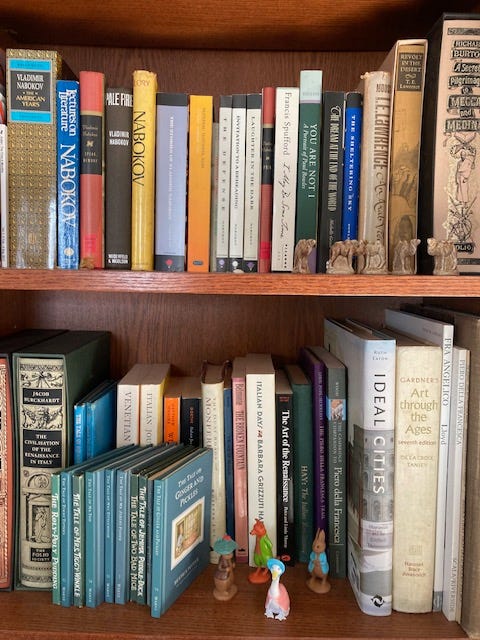
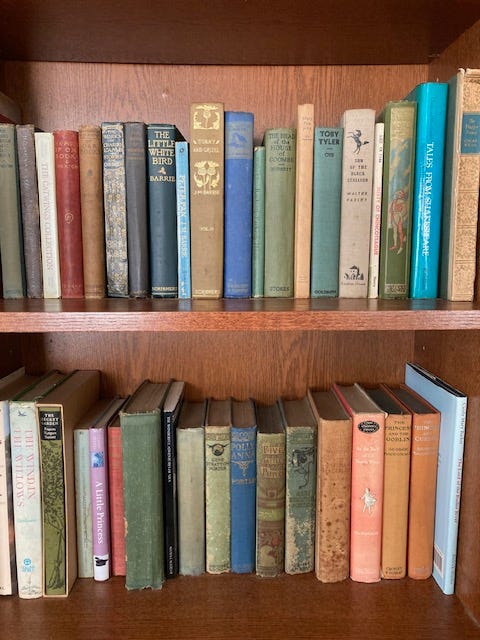
Lest you think I’m too picky, let me say that I finished quite a few other books in January and enjoyed them immensely. The photos of a few of my bookshelves show books that I love.
Have you ever started a book and not finished it? What made you give up on it?
My book group recently chose Theo of Golden for our monthly read. I had to listen to it on Audible because it wasn’t available through the library. The narrator, David Morse, a fine actor, put on a strange European accent, which bothered me. But the book itself was so annoying. Treacle. I got so tired of Theo telling everybody he met how perfect they were. My husband accused me of being too cynical (he liked the book.) I didn’t finish it.
Recently, I put down a book which I became increasingly convinced had been partially written by AI. Plus, I was never able to finish George Meredith's The Egoist, despite several attempts! Also, I'e had to abandon some of the 'continuator' books by well-known writers who take up the mantle of expired greats.